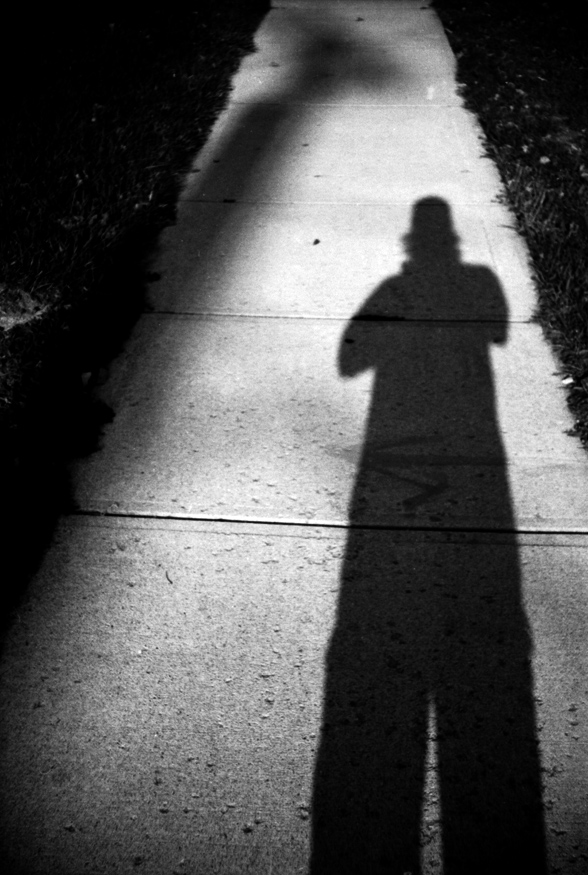
Here is the Tmax 100 I shot with the yashica. I was complaining to stephanie that I needed another film body to carry around with me, for color film, and she arrived one day with this little beauty. At first, I was squeamish. I mean, point and shoot? Really? No control over exposure or focus? Its like a perverse little Holga-thing. But no. It has a little focus button that does pretty well. It also exposes nicely, and the lens on the tiny bugger isnt bad either. So, enough complaining. I shot this at 160EI and 200EI via the rotating exposure ring on the face of the camera. It seems do be damned accurate too. Whether in tribute to the machinery of Yashica, or in detriment to my skills as a photographer, this is my favorite roll of Tmax 100 so far. This particular tmax is about 11 years old having expired in 2000. I was quite pleased, I hope you are as well.
Monday, November 15, 2010
Thursday, November 11, 2010
Kodak Technical Pan
Kodak technical pan film was an 'almost' panchromatic film, which means it responds to the whole spectrum of light. We don't have to worry about this much nowadays, because all black and white film is panchromatic. At one time, black and white film was Orthochromatic, meaning it responded very weakly to red spectrum.
In every photo forum I have visited, someone is there singing the praises of kodak tech pan film. It supposedly leans more to the red spectrum of light, simulating the application of a red filter to the lens, and darkening blues (sky) and lightens reds. I shot this roll at 200ASA, as reccomended. It is supposed to have a very wide exposure latitude, but the sharpness I got with my new Mamiya Sekor DTL1000 and sekor 55mm lens seems sufficient at 200EI...I might try 16EI with the next roll I come across to see if the claims about the film are true. All in all, it was a great test for the new/old camera and even though the film was expired at least 6 years ago, it performed nicely.
Labels:
200ASA,
cheesburger,
Expired Film,
Kodak Technical Pan,
mouse,
shannon,
tmax developer
Tuesday, November 9, 2010
Cross-Processing with Fuji RHP 64T
Here are my first experiments in cross processing E-6 film in C-41 process. I used Rollei/Compard Digibase Chemicals for this development, and developed at standard times and temperatures. I enjoyed the effects, though, some of these shots have me completely baffled as to how they turned out sharp when the rest are grainy. Cross-processing is for me. Next, for bleach bypass, another weird process that leaves the silver on the color negative. I can't wait. I believe I shot this film at 100 or 200EI, seems a bit under-exposed.
Labels:
Canon AE-1 program,
Cross Process,
fuji RHP 64T,
tungsten
Monday, November 8, 2010
Blast from the past, Agfa 400 Expired 1986
To be honest, I really wanted to load these up one at a time, and write poems for each of them. They are good memories, and strong emotional images for me. I may do so, at some later date. This Agfapan film I picked up at Loomis Camera, a great place. The owner often sells highly expired films, and always comments that "the dust is free". There are many wonderful items there, enlargers, ancient cameras, accessories and lenses....but, I digress. This film is 400ISO shot at 1600EI, developed in Tmax developer. It did expire in 1986, and in retrospect, I should have shot it at box speed, and not pushed it at all...Live and Learn. The tones it produced at a 2 stop push were pretty nice, by my standards, and even though there is some 'underdevelopment' going on, or 'underexposure', none of the highlights are blocked up and there is still a pretty wide range of tonality, even if I sacrificed some sharpness. I'll never complain about expired film again after this. I'll just assume I screwed up somewhere and try to figure out where. :)
Sunday, November 7, 2010
Double Exposure Project (part 2)
Here is the second half of the project. There are lots of single images in the melee' that I chose to leave joined, rather than to separate. Derek did a better job of that in his blog. Again, I was taken by the singular appearance of some of the 'compositions' that looked as though they were planned. This was a great experiment, I can't wait to try it with color. I may go shoot the color photos today...:)
Saturday, November 6, 2010
Double Exposure Project (part 1)
Recently, I sent a few surplus rolls of Fuji Neopan Acros 100 film to my friend Derek, in Michigan. I also began reading up on several photo projects I could do that would increase my knowledge and proficiency. I came upon the idea of doing a double-exposure project with Derek, and he said he was game, so we began. Initially, he shot whatever he felt like shooting, and then I shot whatever I felt like shooting. It was uncanny how some of the exposures were of nearly the same subject matter, even though we had not conferred on the subject at all. Here is the first portion of the project. Many of the exposures worked like murals, several images over several overlapping frames, due to the different cameras used. Here are the first few.
Tuesday, November 2, 2010
Learning about Filters (camera motion)
For this end of the experiment, I decided to use the idea of forced motion of the camera to sustain a 'wiggly'
effect. Mostly, I just used slow aperture and shutter speeds, firing and twisting the camera at the same time. I used a fairly busy arrangement, so that there would be a blend of noise created by the motion that would be somewhat asthetic. I also used a range of motions from 180 degree twisting, to lateral and vertical motions. Here are the results, shot through a Lt. Blue filter, using Kodak CN400 film.
Labels:
black and white,
camera motion,
filters,
kodak cn400,
motion
Subscribe to:
Posts (Atom)